By Shannon Green & Kairo Sharman
Most people see Jamaica as a vacation. A postcard. A soundtrack. A place to escape winter while pretending rum is a personality trait. Humanity really has a talent for reducing strategically important places into cruise ship brochures and refrigerator magnets.
But what if Jamaica is something far more important?
What if this small Caribbean island is quietly becoming one of the most strategically valuable locations on Earth?
Not because of beaches. Not because of tourism. Not even because of culture, although Jamaica’s cultural influence is wildly disproportionate to its size.
The real reason is far bigger: location, resources, energy potential, and geopolitical positioning.
And history tells us something uncomfortable about places that suddenly become valuable……… The world notices.
Value Changes Everything
Think about an empty piece of land in your own community. For years nobody cares about it. Bush grows wild. People drive past without noticing. Then suddenly a new highway is announced. A shopping centre gets approved. A major employer moves nearby.
Overnight, that same neglected land becomes “prime real estate.”
The land itself did not change. Perception changed. Value changed. And once value changes, attention follows.
Countries operate the same way. Nations are not just societies, they are strategic assets. Their importance is measured by three things resources, influence, and positioning.
Positioning is often the most powerful of all. A mediocre business at a busy intersection can outperform a brilliant business hidden on a quiet road. Geography matters. Access matters. Connectivity matters.
And Jamaica sits at one of the most important intersections in the Western Hemisphere.
Jamaica’s Strategic Position
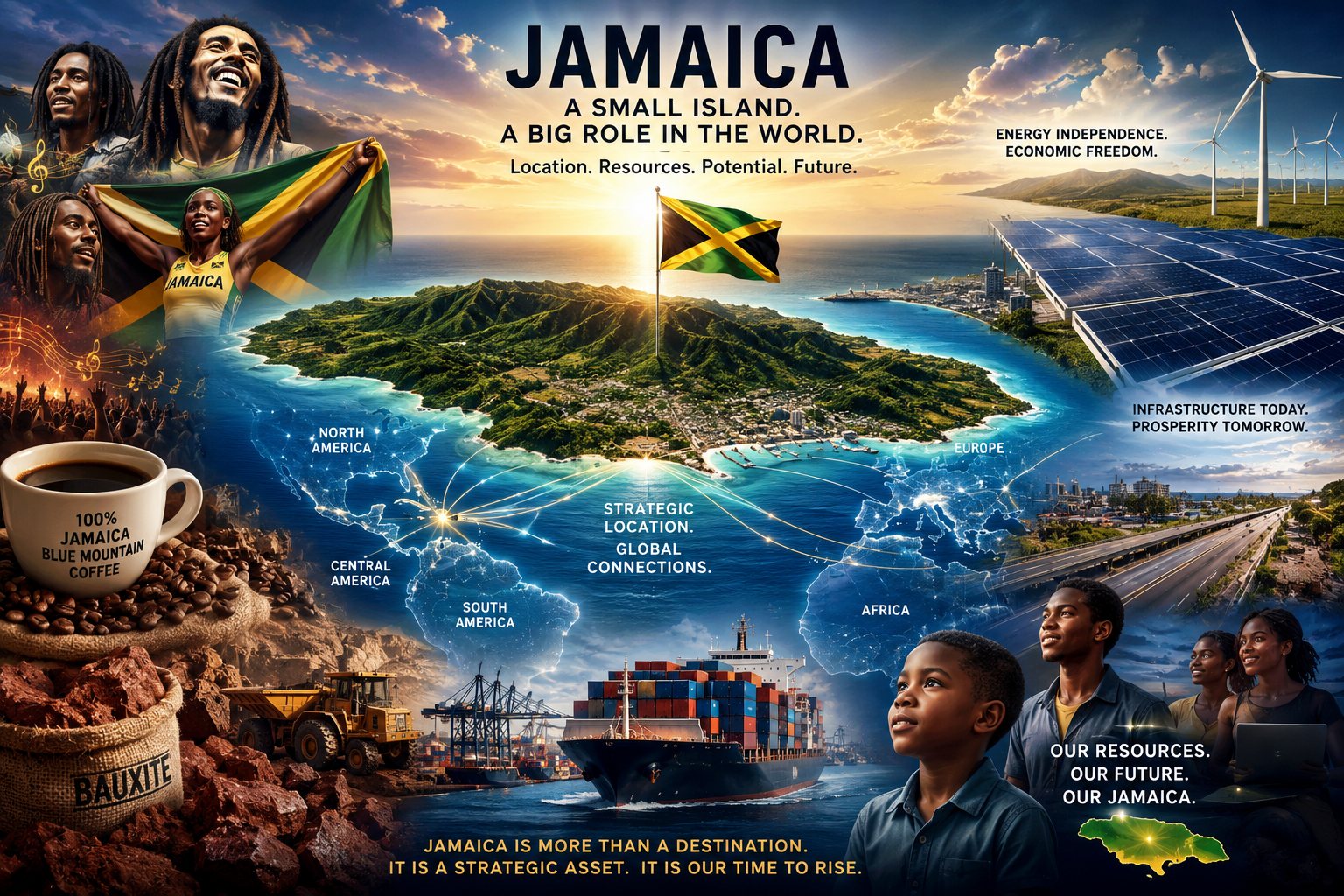
Take a map and stop looking at Jamaica as a small island. Instead, look at the shipping lanes. Look at proximity. Look at access to North America, South America, Central America, the Panama Canal, and major Atlantic trade routes.
Roughly 90% of global trade moves by sea. Jamaica sits near some of the busiest maritime pathways in the Americas.
In geopolitical terms, Jamaica is positioned like premium waterfront property beside an economic highway that never sleeps.
Countries do not compete only for land anymore. They compete for logistics, influence, ports, data routes, shipping corridors, energy systems, and regional leverage. Jamaica sits in the middle of that conversation, whether many Jamaicans realise it or not.
The Resource Story Is Bigger Than People Think
Jamaica already plays a significant role in global supply chains. The country has long been a meaningful producer of bauxite, a key ingredient in aluminium manufacturing. Aluminium powers modern civilisation: aircraft, vehicles, construction, electronics, and renewable energy infrastructure.
At one point, Jamaica supplied a substantial share of global bauxite demand. But the bigger story is potential. Potential oil discoveries. Potential mineral expansion. Potential logistics dominance. Potential renewable energy leadership.
Even the possibility of these developments increases strategic interest. Markets price future value long before the future arrives.
Blue Mountain coffee commands some of the highest prices in the world. Agriculture, limestone, construction materials, and an emerging offshore resource frontier round out a profile that goes far beyond what the island’s reputation suggests.
Energy Could Change the Entire Equation
Jamaica imports a large share of its energy, making electricity costs painfully high for households and businesses. Every Jamaican family understands the emotional trauma known as the light bill.
But Jamaica also possesses one of the most overlooked assets in the modern economy, sunlight. The island receives approximately 3,000 hours of sunshine annually. That creates extraordinary solar potential.
Imagine communities generating decentralised energy. Businesses dramatically reducing operational costs. Rural areas gaining true energy independence. Manufacturing becoming competitive in ways it has never been before.
Energy independence is not merely an environmental issue. It is a sovereignty issue. Countries that control energy control large portions of their economic destiny.
Modern Power Rarely Looks Like Invasion
When people hear phrases like “global interest” or “takeover,” they often imagine military occupation. That is outdated thinking.
Modern influence is quieter.
Today, power often arrives through debt, investment, infrastructure financing, ownership stakes, strategic partnerships, supply chain dependency, and political influence. If foreign entities finance your infrastructure, influence your industries, own strategic assets, or shape your economic decisions, direct control becomes unnecessary.
This is not conspiracy theory. It is geopolitical reality. History repeatedly shows that nations with valuable resources or strategic locations attract external interest. Iraq, Venezuela, Panama, Grenada, and Haiti all demonstrate different versions of this pattern — not identical situations, not identical outcomes, but similar dynamics.
Where value exists, competition follows.
Jamaica Must Think Bigger About Itself
One of the greatest dangers facing resource-rich or strategically positioned nations is psychological. Sometimes the people closest to value fail to recognise it. Outsiders often see opportunity before locals do.
Jamaica cannot afford to think of itself merely as a tourism economy. Tourism matters, but it is only one layer of a much larger strategic identity. The island could become a renewable energy hub, a logistics and shipping powerhouse, a regional financial gateway, a digital infrastructure centre, a specialised manufacturing zone, a diaspora investment magnet, and a Caribbean innovation platform.
But that requires vision. It requires leadership willing to think in decades instead of election cycles…. Note I said leadership, not government. It requires citizens who understand that sovereignty in the 21st century is economic, technological, and infrastructural, not merely political.
The Real Question
The question is not whether Jamaica has value.
The question is whether Jamaicans fully understand the scale of that value before the rest of the world positions itself around it.
Because once global capital, governments, and multinational interests recognise strategic opportunity, the game changes. Gradually at first. Then suddenly.
Jamaica is more than a destination. It is a crossroads. And crossroads have always mattered in human history.
The nations that recognise their strategic importance early tend to shape their future.
The ones that do not often discover too late that someone else already has.
Jamaica is not just a place on the map. It is a strategic opportunity in motion. Join the conversation before the future arrives without us.
To discuss investment, development, partnerships, or strategic opportunities in Jamaica, contact:
Shannon Green – shannon@greenlending.ca