For generations, land ownership in Jamaica has represented more than a financial asset. Land has symbolized security, family legacy, resilience, and opportunity. Yet many landowners continue to make a decision that, while understandable, often leaves millions of dollars of future value on the table: they sell too early.
Across Jamaica, rising demand for housing, tourism-related developments, mixed-use projects, retirement communities, and income producing properties has created a new reality. Land is no longer simply something to own. It is something that can be leveraged strategically.
Increasingly, landowners are discovering another path: Joint Venture (JV) development partnerships.
Instead of selling land outright for a one-time payment, a growing number of property owners are partnering with developers, investors, and project teams to unlock significantly greater long-term value.
The question many landowners are now asking is simple:
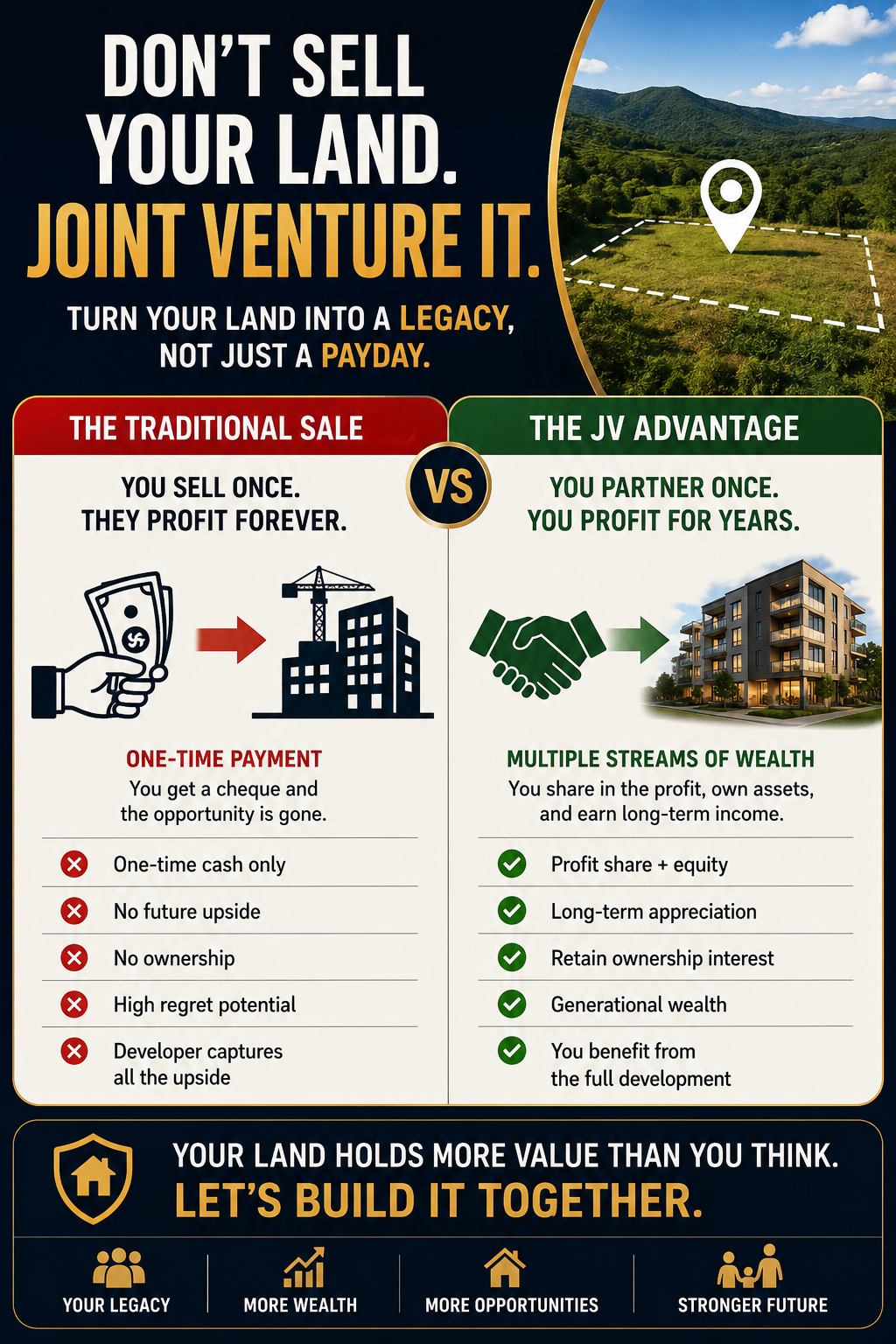
Why sell your land when you can build wealth with it?
The Traditional Land Sale Problem
The conventional process is straightforward.
A developer approaches a landowner.
A price is negotiated.
The landowner receives payment.
Ownership transfers.
Transaction complete.
Or is it?
What many sellers later discover is that the land they sold for a few million Jamaican dollars eventually becomes:
- Housing developments
- Apartment complexes
- Villas or Airbnb communities
- Commercial projects
- Mixed-use developments
The developer often captures most of the future profit.
The landowner receives a cheque once.
The developer may benefit for decades.
This is not necessarily unfair. Developers take risk, invest capital, and manage projects. However, many landowners are increasingly asking whether there is a better way to participate in the upside.
For many, the answer is yes.
What Exactly Is a Joint Venture?
A Joint Venture is a partnership structure where:
The Landowner Contributes:
- Land
- Site control
- Development opportunity
The Developer Contributes:
- Financing
- Construction management
- Architects and engineers
- Project approvals
- Contractors
- Sales and marketing
- Project expertise
Both parties then share in the value created.
Instead of selling the land, the owner contributes it as equity.
The result?
The landowner moves from being simply a seller to becoming a development partner.
Why More Landowners Are Choosing JV Structures
- Greater Financial Upside
The largest advantage of a JV is simple:
More upside.
A parcel sold today for a fixed amount may generate many times that value after development.
For example:
Traditional Sale:
Land sold for J$20M
JV Development Scenario:
Land contributes toward a project generating substantially larger development profits plus potential ownership interests.
While every project differs, JV structures often provide exposure to:
- Profit participation
- Equity ownership
- Income-producing units
- Long-term appreciation
Selling creates liquidity.
Partnership creates leverage.
- You Keep Ownership Exposure
Landowners frequently worry:
“If I don’t sell, how do I benefit?”
In many JV structures, ownership interests remain protected through legal agreements, share structures, development entities, or profit-sharing arrangements.
This means landowners may continue participating in:
- Future appreciation
- Rental income
- Equity growth
- Additional project phases
You are no longer only exiting the opportunity.
You remain connected to it.
- Lower Capital Requirements
One major barrier preventing landowners from developing themselves is cost.
Development requires:
- Infrastructure
- Financing
- Permits
- Engineering
- Construction teams
- Working capital
Many landowners have land but not millions in available development capital.
A JV solves this problem.
The developer provides expertise and funding capacity while the landowner contributes the underlying asset.
Your land becomes your investment.
- Reduced Development Burden
Building projects is difficult.
Managing consultants, permits, contractors, cost overruns, financing, and timelines requires expertise.
Many JV arrangements allow landowners to participate in the upside without managing day-to-day execution.
You remain involved in major decisions while professionals handle operations.
Why Jamaica’s Market Conditions Matter Right Now
Timing matters.
Jamaica currently faces significant housing supply pressures across multiple segments.
Demand continues expanding due to:
- Urbanization
- Returning diaspora interest
- Tourism expansion
- Growing middle-class demand
- Retirement and lifestyle migration
- Short-term rental growth
- Population shifts into growth corridors
The result?
Inventory shortages remain a major challenge.
Limited supply often reduces one of the biggest fears in development:
Absorption risk.
Absorption risk refers to whether completed units can actually be sold or rented.
In markets with insufficient inventory, this risk may be lower because unmet demand already exists.
That does not mean every project succeeds automatically.
It does mean market fundamentals currently favour carefully planned development opportunities.
Family Land and Legacy: The Conversation Many Families Avoid
Across Jamaica, family land remains one of the country’s most valuable and underutilized resources.
Unfortunately, family land often creates pressure:
- One sibling wants cash now
- Another wants to hold forever
- Others disagree on value
Selling becomes the easiest option.
But easy and optimal are rarely the same thing.
A properly structured JV can create alternatives:
- Shared income streams
- Unit allocations
- Equity participation
- Structured family ownership
Instead of dividing value, families may be able to multiply it.
Important Questions Before Entering Any JV
Not every project is suitable.
Landowners should evaluate:
- Zoning and approvals
- Road access
- Infrastructure availability
- Title issues
- Development economics
- Developer experience
- Legal protections
- Exit structures
Professional legal, accounting, valuation, and planning advice remains critical.
A strong JV is built on transparency and structure.
Not promises.
Final Thoughts: From Landowner to Partner
The traditional land sale model is simple.
But simple is not always best.
For many landowners, particularly those holding strategically located or underutilized property, the bigger opportunity may not be selling.
It may be partnering.
A Joint Venture allows landowners to:
✓ Participate in future value creation
✓ Reduce financial barriers
✓ Preserve ownership interests
✓ Create long-term income opportunities
✓ Build generational wealth
Land has always created wealth in Jamaica.
The question is whether landowners will continue transferring that wealth away… or participate directly in creating it.
Interested in Exploring Whether a Joint Venture Could Work for Your Property?
To discuss whether a JV structure may benefit your land, property, or family holdings, contact:
Kairo Sharman
Email: consulting.inc1@hotmail.com
A conversation costs nothing.
Selling too early might.